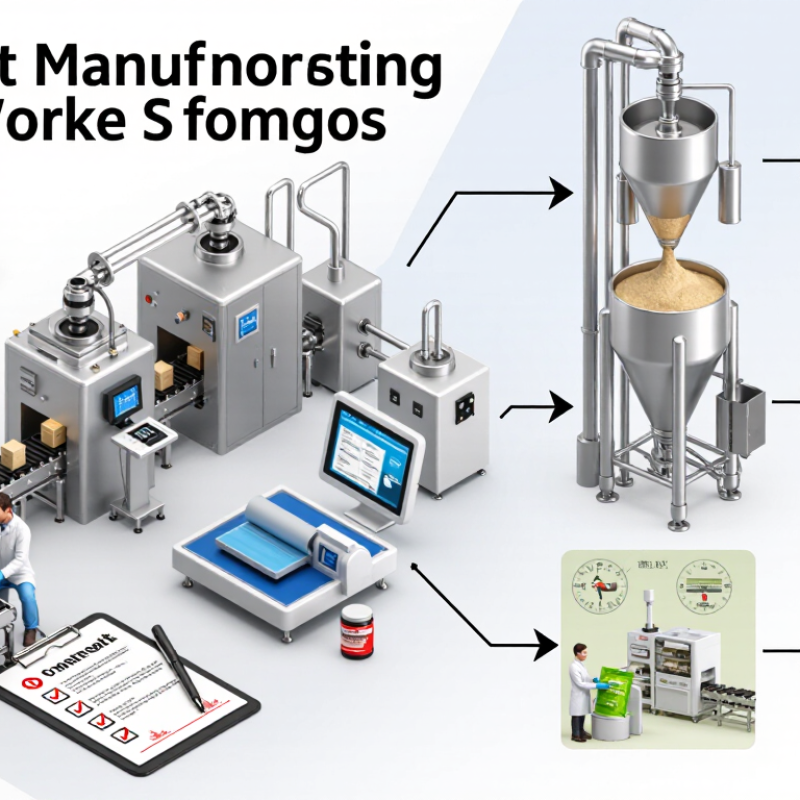
Choosing among the top Pre-Workout Powder Contract Manufacturers requires more than comparing prices, flavors, or glossy websites. A reliable partner must understand formulation science, ingredient stability, allergen control, batch documentation, and practical production limits. The strongest manufacturers can explain how caffeine, creatine, beta-alanine, amino acids, and flavor systems behave during blending and storage. They should also provide clear certificates of analysis, identity testing, and finished-product verification.
Quality begins inside the process.
W. Edwards Deming, a respected manufacturing quality authority, wrote, “Quality comes not from inspection, but from the improvement of the production process.” That principle remains highly relevant to Pre-Workout Powder Contract Manufacturing. Testing the final powder matters, but consistent weighing, controlled humidity, validated cleaning, and traceable suppliers matter earlier. One overlooked moisture problem can turn a free-flowing powder into hard lumps. A weak flavor system can also damage repeat sales, even when the formula performs well.
This guide evaluates manufacturers through an evidence-based lens. It considers facility experience, formulation support, minimum order quantities, packaging options, lead times, quality systems, and communication. Certifications can strengthen confidence, but they do not replace direct questions or document review. No shortlist is perfect. A manufacturer may excel at sports nutrition yet struggle with small launches or rapid revisions. Brands should request samples, review specifications, and clarify testing responsibilities before signing an agreement. The right partner is not simply the cheapest option. It is the one that can repeatedly deliver safe, consistent powder with honest documentation and dependable support.
Top Pre Workout Powder Contract Manufacturers?
Define the Pre-Workout Powder Market Using 2024 CAGR Forecasts
In 2024, the pre-workout powder market is shaped by demand for convenient energy, focus, and training support. Published CAGR forecasts often range from mid-single digits to low double digits. The difference reflects varied regions, product definitions, and research methods. Treat forecasts as planning tools, not promises.
A capable contract manufacturer must convert uncertain growth into repeatable production. During factory assessments, buyers should inspect batch records, allergen controls, raw-material testing, and blending accuracy. A clean powder room matters. So does a practical sampling plan. Manufacturers should explain how caffeine, amino acids, electrolytes, flavors, and sweeteners remain evenly distributed. Uneven blending can create inconsistent servings, even when laboratory results look acceptable.
Forecasts can guide capacity decisions, but they cannot replace market evidence. A small pilot run may reveal poor solubility, excessive sweetness, or settling after transport. These issues are easy to miss in a spreadsheet. Experienced teams compare forecasted CAGR with retailer feedback, regional regulations, ingredient availability, and realistic lead times. They also verify certificates, stability data, and claims review before scaling. Some projections may prove optimistic. That deserves attention. A manufacturer willing to document limits, investigate deviations, and adjust formulas offers more dependable support than one promising the fastest launch.
| Market dimension | 2024 benchmark or forecast | 2024–2030 CAGR indication | Contract-manufacturing implication | Data basis |
|---|---|---|---|---|
| Global pre-workout supplements market | Published market studies generally place the 2024 global market in the low single-digit billions of U.S. dollars; estimates differ because some reports include capsules, drinks, and ready-to-drink products. | Approximately 7%–10% | Demand supports scalable powder blending, flavor development, and flexible minimum order quantities. | Range synthesized from 2024 public market-research forecasts; scope varies by publisher. |
| Pre-workout powder segment | Powder remains the principal delivery format because it allows higher active-ingredient loads, dry stability, and economical shipping compared with ready-to-drink formats. | Usually modeled near the overall category CAGR | Prioritize ribbon or paddle blending, low-moisture handling, anti-caking controls, and sachet or tub filling. | Format and manufacturing characteristics reported across sports-nutrition industry analyses. |
| North America | Largest established demand center for sports and performance supplements, with strong online and specialty-retail distribution. | Approximately 6%–9% | Manufacturers should support U.S. dietary-supplement cGMP documentation, allergen controls, lot traceability, and label review. | U.S. FDA dietary-supplement regulatory framework, including 21 CFR Part 111. |
| Europe | Mature but highly fragmented market with country-specific approaches to ingredient authorization, claims, and notification requirements. | Approximately 5%–8% | Formulas require careful review of permitted substances, maximum levels, language requirements, and nutrition or health claims. | European Union food-supplement and nutrition-claims framework, including Regulation (EC) No 1924/2006. |
| Asia-Pacific | Growth is supported by expanding fitness participation, e-commerce access, and increasing interest in sports nutrition. | Approximately 9%–13% | Export-ready manufacturers need country-by-country ingredient screening, multilingual labels, and stable ambient logistics. | Regional growth ranges reported in publicly available 2024 sports-nutrition forecasts. |
| Common active-ingredient architecture | Frequently used categories include caffeine, creatine, beta-alanine, citrulline compounds, electrolytes, taurine, and vitamins. | Not applicable; formulation-dependent | Require identity testing, potency verification, segregation of sensitizing materials, and control of hygroscopic ingredients. | Ingredient functions and regulatory status must be verified for each target market before commercialization. |
| Typical commercial pack formats | Single-serve sachets and multi-serve tubs are the dominant powder formats in direct-to-consumer, gym, and retail channels. | Not applicable; format mix varies by channel | A capable facility should offer automated weighing, blending, metal detection, filling, sealing, coding, and finished-goods inspection. | Standard dry-powder packaging practice in the sports-nutrition sector. |
| Quality and certification expectations | Buyers commonly request cGMP compliance, HACCP-based controls, laboratory testing, traceability, and a documented recall procedure. | Not applicable; qualification criterion | Prioritize audited quality systems, supplier qualification, certificate-of-analysis review, and batch-to-batch uniformity. | FDA 21 CFR Part 111, HACCP principles, and ISO 22000 food-safety-management concepts. |
| Illustrative CAGR sensitivity index | If the 2024 market is indexed at 100, a 2030 index would be approximately 142 at 6% CAGR, 159 at 8% CAGR, and 177 at 10% CAGR. | 6% / 8% / 10% scenarios | Use the sensitivity range for capacity planning rather than relying on a single market-size estimate. | Calculated as 100 × (1 + CAGR)6; an analytical index, not a reported market value. |
Top Pre Workout Powder Contract Manufacturers?
Selecting a pre-workout powder manufacturer requires more than comparing price, flavor, or minimum order quantity. FDA 21 CFR Part 111 requires written specifications for identity, purity, strength, composition, and contamination limits. Ask for evidence, not promises. A qualified facility should maintain a master manufacturing record, batch production records, equipment-cleaning logs, and documented quality-control reviews.
Look closely at testing. Each ingredient should have identity verification before use, while finished batches need scientifically valid testing. For stimulant-containing formulas, reviewers should examine assay results, allergen controls, foreign-material prevention, and out-of-specification investigations. FDA inspection and warning-letter records repeatedly identify weak documentation, inadequate testing, and incomplete investigations as common CGMP concerns. The details matter. A missing signature can become a serious traceability problem.
Market pressure makes this comparison more important. The 2024 Council for Responsible Nutrition Consumer Survey reported that 75% of U.S. adults use dietary supplements. Meanwhile, Grand View Research valued the global sports nutrition market at approximately $45.27 billion in 2023. Growth can encourage rushed production. That is where manufacturers may cut corners, sometimes unintentionally. Request recent third-party audit reports, laboratory accreditation details, recall procedures, reserve-sample controls, and employee training records. Then verify whether those documents match actual warehouse practices. A polished audit packet is not proof by itself. Dig deeper.
When assessing a contract manufacturer, caffeine and beta-alanine data reveal more than a polished label. The International Society of Sports Nutrition reports that caffeine commonly supports performance at 3–6 mg per kilogram of body weight. A 75-kilogram athlete would therefore receive about 225–450 mg. That range is not automatically suitable for everyone.
Check whether the manufacturer states exact dosages per serving. “Clinical dose” sounds persuasive, but it proves little without numbers. Beta-alanine needs closer inspection. The ISSN position stand identifies 4–6 grams daily for at least two to four weeks as a commonly studied intake. A single scoop containing 1.6 grams may look impressive, yet it may not match the studied daily exposure. Timing matters less than consistent intake.
Ask for a certificate of analysis showing assay results, batch numbers, and testing methods. Independent laboratory verification is stronger than a supplier’s internal spreadsheet. Examine caffeine variation between batches, because small deviations can affect a stimulant-heavy formula. Also review serving-size mathematics. Some powders list a large scoop but hide underdosed active ingredients inside it.
The evidence has limits. Research doses do not guarantee identical real-world results. Personal tolerance, body weight, sleep, and total daily caffeine all matter. A manufacturer willing to discuss these limitations may demonstrate better technical judgment than one promising instant transformation. Formulation quality should survive scrutiny, not merely taste testing.
A top pre-workout powder contract manufacturer should prove testing, not merely display a certificate. NSF’s Certified for Sport program screens for more than 290 prohibited substances, according to its published program requirements. Ask for the current testing scope, laboratory identity, sampling method, and lot-specific reports. A glossy certificate is not enough.
The U.S. Food and Drug Administration states that dietary supplement companies are responsible for product safety and accurate labeling before marketing. That makes supplier qualification essential. Review raw-material specifications, identity testing, microbial results, heavy-metal data, and finished-product potency. Request chain-of-custody records for every sample. The powder should match its label in a real laboratory, not only on paper.
Walk through the facility, if possible. Check sealed containers, calibrated scales, cleaning records, and separate production areas. A 2023 analysis in the Journal of the International Society of Sports Nutrition found that supplement labels and contents do not always align, reinforcing the need for independent verification. I would also test retained samples after production. It costs more, but one overlooked lot can damage trust quickly. No system is perfect. That uncomfortable fact deserves attention.
Use independent certification and prohibited-substance testing as core criteria when evaluating a contract manufacturer.
The chart groups the 2025 WADA Prohibited List by restriction status: six substance groups and three method groups are prohibited at all times, while four substance groups are prohibited in competition only. NSF Certified for Sport testing is broader than these category counts because it screens finished products for more than 290 prohibited substances.
References: NSF Certified for Sport · WADA Prohibited List
The strongest contract manufacturers rank well across four practical measures: MOQ, lead time, certification, and cost. Low-MOQ suppliers often accept 500 to 1,000 kilograms per formula. Their lead time may reach eight to twelve weeks. Mid-volume facilities commonly require 2,000 to 5,000 kilograms. They may ship in six to ten weeks. Large producers can offer lower costs, but their minimum orders may exceed 10,000 kilograms.
Certification should come before pricing. Look for current GMP, HACCP, and ISO 22000 documentation. Independent laboratory testing should verify identity, purity, allergens, and contaminant limits. Ask for batch records and a recent audit report. A polished certificate is not enough. I have seen suppliers provide excellent documents but weak sample consistency. That gap deserves attention.
Cost benchmarks usually range from $8 to $18 per kilogram for bulk powder. Custom flavoring, small sachets, testing, and complex packaging increase the final quote. Lead times also expand during seasonal demand. Supplier ranking should therefore use a weighted score, not the lowest price alone. A practical ranking gives certification 35%, quality evidence 25%, lead time 20%, MOQ 10%, and cost 10%.
Tips: Request three identical samples from one batch. Compare flavor, mixability, and sediment after ten minutes. Confirm whether freight, testing, and packaging appear in the quoted price. Leave contingency time for label review and formula changes. Mistakes happen. Plan for them.
Request identity, purity, microbial, heavy-metal, allergen, and potency testing. Ask for lot-specific reports and the laboratory’s name. A certificate alone is not enough.
A strong program may screen for more than 290 prohibited substances. Confirm the current scope. Testing programs can change.
They show how each sample moved from production to the laboratory. Request records for every tested lot. Paper trails matter.
Check sealed containers, calibrated scales, cleaning logs, and separate production areas. Look for clear storage labels and controlled access. Small details reveal weak routines.
Review current GMP, HACCP, and ISO 22000 documentation. Also request a recent audit report and batch records. Documents need verification.
Smaller suppliers may accept 500 to 1,000 kilograms per formula. Mid-volume facilities may require 2,000 to 5,000 kilograms. Large producers may exceed 10,000 kilograms.
Smaller orders may take eight to twelve weeks. Mid-volume production may require six to ten weeks. Seasonal demand can extend both timelines.
Bulk powder often ranges from $8 to $18 per kilogram. Flavoring, sachets, testing, and packaging can raise the quote. Freight may appear separately.
Request three identical samples from one batch. Compare flavor, mixing, and sediment after ten minutes. Retained-sample testing costs more, but it may catch overlooked problems.
This guide explains how to evaluate the growing pre-workout powder market using 2024 CAGR forecasts and practical supplier benchmarks. It outlines how Pre-Workout Powder Contract Manufacturing partners should be compared against FDA 21 CFR Part 111 requirements, including documented quality systems, ingredient traceability, production controls, and finished-product testing. The goal is to help businesses identify manufacturers capable of delivering consistent, compliant, and scalable products.
Formula assessment focuses on transparent caffeine and beta-alanine dosage data, serving accuracy, and evidence supporting product quality. The guide also emphasizes testing standards, including screening for NSF’s 290+ banned substances, to reduce contamination and labeling risks. Finally, suppliers are ranked according to minimum order quantities, lead times, certifications, testing capabilities, and cost benchmarks, giving buyers a structured framework for selecting a reliable manufacturing partner.